
Small Bathroom Remodel Cost: What to Budget in 2026
Most small bathroom remodels in the U.S. land between $3,000 and $18,000, depending on whether you are refreshing surfaces or gutting the room. This Old House puts cosmetic updates at $3,000 to $8,000 and full renovations at $8,000 to $18,000 or more. In California, where labor costs more, plan on the upper half of those ranges or above. Below you will find what each budget level buys, where the money goes, and how to keep a small room from costing like a big one.
TL;DR
- Nationally, a small bathroom remodel runs about $3,000 to $8,000 for a cosmetic refresh and $8,000 to $18,000 or more for a full renovation.
- Labor is the biggest line, commonly 40% to 65% of the total. Moving plumbing is the biggest avoidable add-on.
- California jobs usually price above national averages. Expect to be at the top of the national range, or past it, once demolition, waterproofing and tile are included.
- Keep the layout, choose stock fixtures, and spend on the things hidden behind the walls and under the tile. Those fail expensively.
Table of Contents
- What a small bathroom remodel costs nationally
- Three budget tiers and what each one buys
- Where the money actually goes
- Why California costs more
- Can you remodel a small bathroom for $5,000 or $10,000?
- What pushes a small bathroom budget up
- How to keep the cost down without cutting corners
- Our perspective: where small-bathroom money should go
- Get a bathroom estimate from Darling Flooring
- FAQ
- Sources
What a small bathroom remodel costs nationally
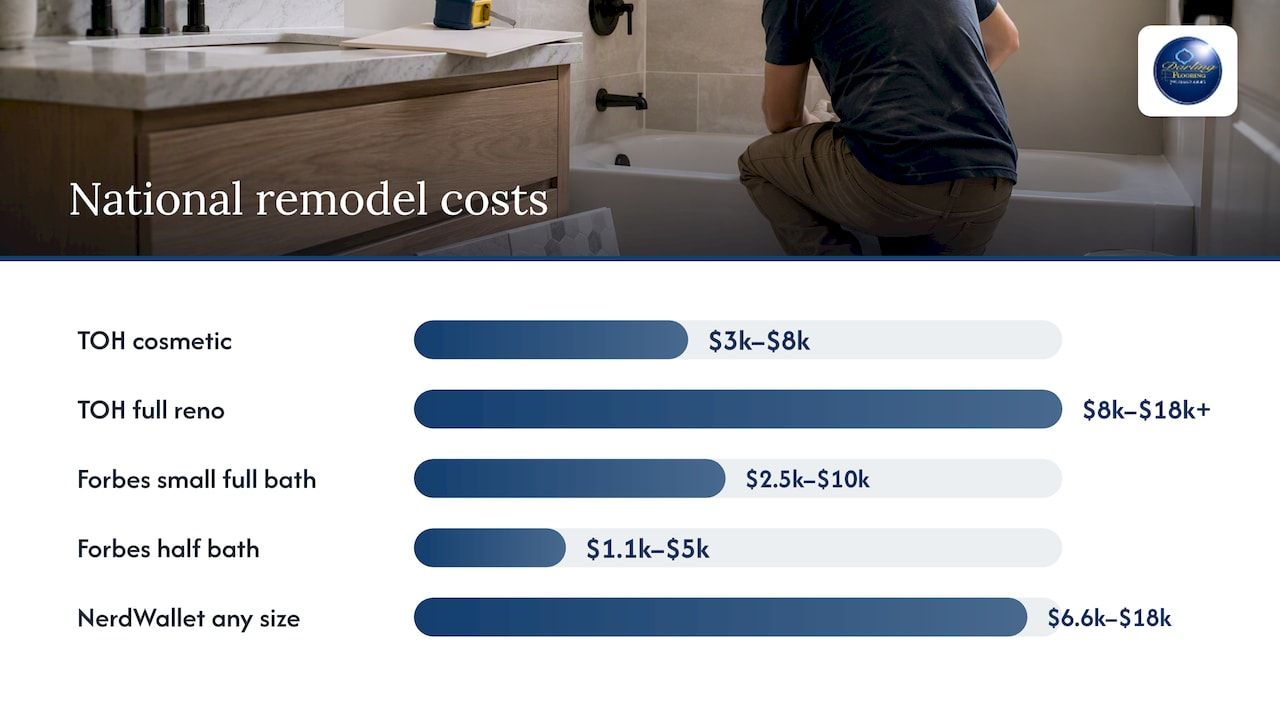
No single number is right, because “small bathroom” covers a 25 sq. ft. powder room and a 60 sq. ft. hall bath with a tub. Published averages still give you a useful frame:
| Source | Scope | Range |
|---|---|---|
| This Old House | Cosmetic update | $3,000 to $8,000 |
| This Old House | Full renovation | $8,000 to $18,000 or more |
| Forbes Home | Small full bath | $2,500 to $10,000 |
| Forbes Home | Half bath or powder room | $1,100 to $5,000 |
| NerdWallet | Bathroom remodel, any size | about $6,600 to $18,000 |
Forbes Home gives an average of $6,300 for a small bathroom. Treat that as a midpoint for a fairly simple job in an average-cost market, not as a quote.
The spread between sources is itself information. The low figures assume you keep most of what is there. The high figures assume demolition, new waterproofing, tile and a contractor doing all of it.
Three budget tiers and what each one buys
Refresh: roughly $3,000 to $8,000
A refresh keeps the tub, toilet and layout. You replace the vanity and faucet, swap lighting and mirror, repaint, and perhaps lay new flooring. Nothing behind the walls changes. This is the tier where small, smart choices, such as budget-minded painting and decorating ideas, stretch the money furthest.
If the existing shower or tub is sound and the walls are dry, a refresh is often the best value. If you see soft grout, a spongy floor or stains below the tile, it is not a refresh anymore. Our guide on finding a leaking tile shower without removing tile explains how to tell before you spend.
Full renovation: roughly $8,000 to $18,000 or more
Here the room is taken to the studs. You get new tile, a new tub or shower, a new vanity and toilet, updated electrical and a proper waterproofing system. This is what most homeowners picture when they say “remodel”, and it is where labor shows up in full.
Layout change: add to the full-renovation figure
Moving the toilet, shifting a drain or swapping a tub for a walk-in shower with a new drain location can push the budget well beyond a standard gut job. NerdWallet notes that changing the floor plan can add about $5,000, because plumbing and electrical both have to move.
Where the money actually goes
On a small job, materials are modest. A bathroom uses little tile and one vanity. Labor and the trades behind the walls take most of the budget.
Labor
This Old House reports that labor is roughly half of the total, and its survey found 49% of homeowners named labor as a major contributor. NerdWallet’s range is wider: labor commonly represents 40% to 65% of the cost.
This is why small bathrooms cost more per square foot than large ones. A plumber, an electrician and a tile setter each have to show up whether the room is 30 sq. ft. or 100.
Demolition, permits and disposal
NerdWallet lists demolition at $1,000 to $2,300 and permits at $100 to $1,000. Permit costs vary by city, and many California jurisdictions require them for plumbing or electrical changes. Ask your contractor who pulls the permit and whether the fee is in the bid.
If you are only removing old tile, see what tile removal costs per square foot. It often surprises homeowners how much of a bid is spent on taking things out.
Materials and fixtures
This Old House identifies material and fixture quality as one of the three biggest drivers, along with labor and layout. Stock vanities, standard tile and builder-grade fixtures keep the number down. Custom tile, premium fixtures and specialty glass push it up.
Tile is where a small room can get expensive fast, because a small floor with a decorative pattern costs the same labor-hours per square foot as a large one, and often more. Simple large-format tile has fewer cuts and fewer grout lines.
The shower or tub
This is usually the single largest decision. Keeping the tub and refinishing or re-tiling around it is the cheapest path. Converting to a walk-in shower costs more, since it involves new plumbing, waterproofing and often a new floor slope. Our breakdown of tub to shower conversion costs and codes
shows what drives that range. If you are considering a zero-threshold design, what a curbless shower really costs
explains why the floor work matters. For a sense of the design trade-offs, this comparison of shower versus bath options
is a good starting point.
Why California costs more
NerdWallet’s national guide notes that regional cost differences come from local cost of living and from material and labor prices. It cites about $20,000 on average in Los Angeles, against a national typical range topping out near $18,000.
In practice that means:
- Labor rates are higher. Licensed trades in coastal and metro California charge more per hour than the national norm.
- Permits and inspections are stricter in many cities, which adds time and fees.
- Older housing stock is common. Older homes often hide galvanized pipe, outdated wiring or subfloor damage that only appears at demolition.
- Small rooms carry fixed costs. A 5 by 8 bathroom still needs the same trades as a larger one.
So a California homeowner should read the national ranges as a floor for a full renovation, not a ceiling. For a deeper look at state pricing, see our California bathroom remodel price guide.
Can you remodel a small bathroom for $5,000 or $10,000?
$5,000
It is possible, with limits. Forbes Home’s small full bath range starts at $2,500, so $5,000 falls inside it. A budget this size works when the layout stays, the tub or shower is reused, and you choose stock items. It rarely covers a full gut with professional tile work in California, where labor alone can consume most of it.
In practice, $5,000 buys a new vanity and faucet, lighting, paint, a new toilet, and either new flooring or a refinished tub surround. Plan for contingency; hidden problems do not stay inside the budget you set for them.
$10,000
$10,000 sits at the top of Forbes Home’s small full bath range and in the middle of This Old House’s full-renovation band. Across most of the country that can cover a tub-to-shower surround retile, a new vanity, toilet, fixtures, and paint. In California, expect it to cover a solid mid-grade remodel only if the layout stays and the room has no hidden water damage. If you are moving the shower drain or relocating the toilet, you will likely need more.
What pushes a small bathroom budget up
This Old House lists the cost-raising items: plumbing relocation, custom tile, electrical work, demolition, permits, water damage and premium fixtures. Of these, water damage is the one you cannot plan for and the one that most often turns a $9,000 job into a $14,000 job.
A few warning signs to look for before you set a budget:
- Soft or discolored drywall around the tub or shower.
- Loose or cracked floor tile, which can mean movement or moisture below. See when a cracked tile floor needs a structural repair.
- A musty smell, or grout that keeps failing in one corner.
- A toilet that rocks, which can signal a rotted subfloor.
Budget 10% to 20% for the unexpected on any job that opens up walls or floors. That is our working rule, not a published standard.
How to keep the cost down without cutting corners
The same sources agree on the main levers. This Old House says keeping the existing layout and choosing stock or standard products generally lowers the total. In order of impact:
- Keep the plumbing where it is. This is the largest single saving, about $5,000 by NerdWallet’s estimate.
- Pick standard sizes. A 30-inch or 36-inch stock vanity and a standard-size tub or shower base avoid custom fabrication.
- Use tile where it counts. Tile the wet zone fully, and use paint or a washable wall panel elsewhere.
- Bundle the work. Tile, flooring and shower work done by one crew means fewer mobilizations and less coordination.
- Decide before demolition. Changes mid-job are expensive. Order fixtures before the walls are open.
- Skip what does not pay back. Our look at bathroom remodel ROI shows why a midrange scope usually beats a luxury one for homeowners.
If the household has accessibility needs, plan that at the start rather than retrofitting. Doing it twice is the costliest option; our piece on accessible bathroom remodels for private homes
covers what to design in.
Our perspective: where small-bathroom money should go
We install tile, build showers and refinish floors every week, so we see where small bathroom budgets succeed and where they fail. Our view is simple.
Spend on what you cannot see. A waterproofed shower pan, a flat and properly prepared substrate, and correct tile setting are what keep the room dry for twenty years. A designer faucet will not fix a leak. If a bid is cheap, check what has been left out, and it is usually the prep.
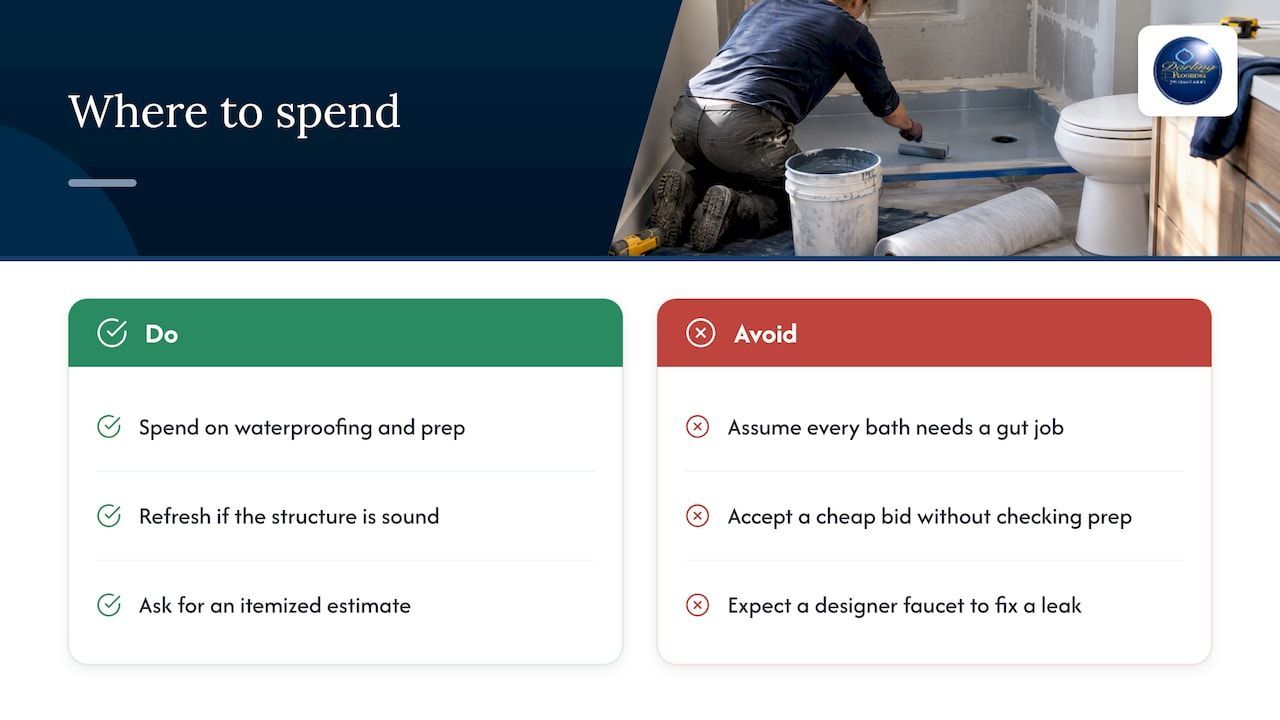
Keep the scope honest. Many small bathrooms do not need a gut job. If the structure is sound, a well-executed refresh of tile, vanity and finishes gives most of the benefit for a fraction of the cost.
Ask for an itemized estimate. A good bid separates demolition, waterproofing, tile, fixtures, labor and permits. That is how we write ours, because a homeowner who understands the number can make better decisions about it. We do not publish flat prices for our work, since every room is different, but we will walk you through what drives your number before you sign anything.
— Jacob
Get a bathroom estimate from Darling Flooring
If you are planning a shower build, new tile floor or full bathroom remodel in California, we offer consultation-led estimates and can bundle tile, shower and flooring work into one project. See our tile installation work
or get in touch through our main site
to talk through scope before you commit to a budget.
FAQ
How much does it cost to remodel a small bathroom in California?
Expect California to run higher than national averages. NerdWallet cites roughly $20,000 on average in Los Angeles for a bathroom remodel, against a national typical range of $6,600 to $18,000. A cosmetic refresh can still come in far lower, while a full renovation with new tile and a new shower will land at the upper end or beyond.
Can you redo a bathroom for $5,000?
Yes, if the scope is a refresh: vanity, faucet, lighting, paint, toilet and possibly flooring, with the existing layout and tub or shower kept. Forbes Home’s small full bath range begins at $2,500. A full gut with professional tile is unlikely to fit in California.
Is $10,000 enough to remodel a small bathroom?
Often, if the layout stays the same and there is no hidden damage. It sits within the full-renovation band that This Old House gives as $8,000 to $18,000 or more. Moving plumbing or choosing custom tile will push past it.
What costs the most in a small bathroom remodel?
Labor. NerdWallet says it commonly makes up 40% to 65% of the total. After labor, the biggest swings come from relocating plumbing, tile choices and any water damage found at demolition.
Does a small bathroom remodel add value?
Usually, but a midrange scope pays back better than a luxury one. We cover this in detail in our bathroom remodel ROI guide.



